
You can be competent, grateful and successful—and still be depleted by your job. The warning often arrives quietly: Sunday-evening dread, shallow sleep, a shorter temper, mistakes you rarely made before, or the feeling that there is nothing left of you when the working day ends.
This is where Occupational Wellness begins: not with a perfect career, but with work that can coexist with health, values, relationships and a life beyond performance.
A better question: Not “Can I keep pushing?” but “Is this way of working sustainable—and what must change?”
Burnout Is More Than Being Tired
The World Health Organization describes burnout as an occupational phenomenon resulting from chronic workplace stress that has not been successfully managed. Its three dimensions are energy depletion or exhaustion, increased mental distance or cynicism toward the job, and reduced professional efficacy. WHO does not classify burnout itself as a medical condition.
Ordinary tiredness usually improves after adequate rest. A concerning pattern persists, returns quickly when work resumes, or begins to alter sleep, mood, concentration, relationships and functioning. Burnout can also overlap with depression, anxiety, sleep disorders, anaemia, thyroid problems and other conditions—so self-diagnosis is not enough.
Nine Signs Your Job May Be Draining You
1. Recovery no longer restores you. A weekend or holiday brings only brief relief; fatigue returns almost immediately.
2. Work dread becomes a bodily reaction. You notice a racing heart, nausea, headaches, muscle tension or agitation before logging in.
3. You are becoming cynical or detached. People feel like interruptions; empathy contracts; work that once mattered begins to feel pointless.
4. Your thinking is less reliable. Concentration, memory, decision-making or creativity decline, and small mistakes increase.
5. Your boundaries keep disappearing. Messages follow you into meals, evenings and sleep; “urgent” becomes the default.
6. Your emotional spillover is growing. Irritability, numbness or withdrawal affects the people and activities you value.
7. Your values and your role are colliding. You are repeatedly asked to act against your standards—or rewarded for outcomes that feel wrong.
8. You feel powerless and unsupported. Priorities shift without consultation; effort goes unseen; asking for help feels unsafe.
9. Your world is shrinking. Movement, friendships, learning and joy are displaced because work consumes all available energy.
Clinical caution: These signs are not a diagnostic checklist. Their pattern, duration, severity and effect on daily functioning matter.
Why Willpower Alone Cannot Fix a Work-System Problem
The Job Demands–Resources model helps explain the pattern. Demands—workload, deadlines, emotional labour, uncertainty and conflict—consume energy. Resources—autonomy, support, role clarity, fairness, feedback and adequate tools—protect health and support engagement. Longitudinal research broadly supports both a health-impairment pathway from excessive demands and a motivational pathway from resources.
A systematic review found that high demands, workload, low control, low reward, job insecurity and weak support were associated with greater exhaustion, while support and workplace justice were protective. This is why breathing exercises may help you regulate in the moment but cannot compensate indefinitely for unsafe staffing, harassment, relentless hours or impossible targets.
The physical-health context also matters. WHO and ILO estimates associate working 55 hours or more per week, compared with 35–40 hours, with higher risks of stroke and ischaemic heart disease. This does not predict any one person’s outcome; it demonstrates why chronic overwork deserves prevention, not admiration.
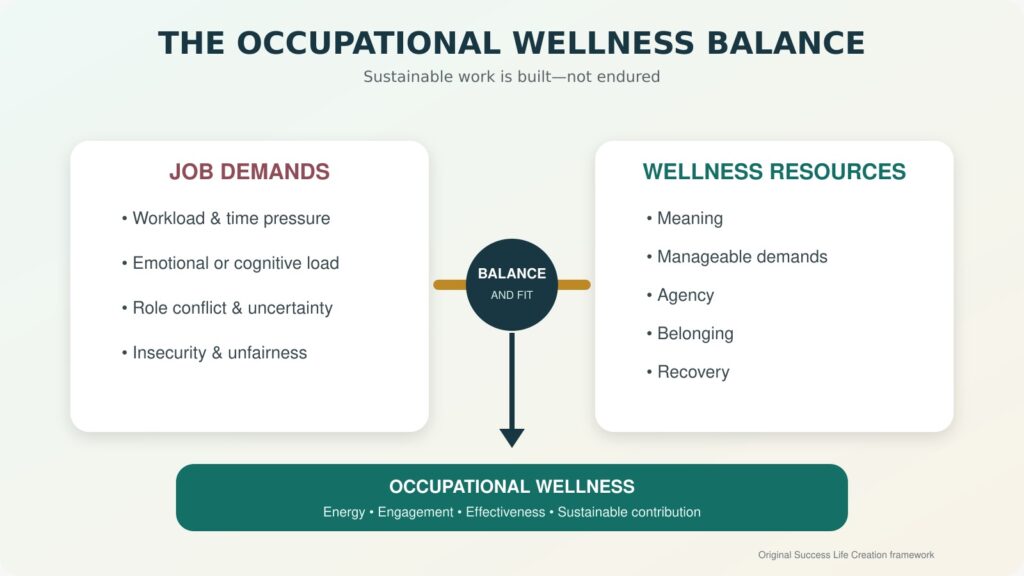
The Occupational Wellness Formula
Occupational Wellness = Meaning + Manageable Demands + Agency + Belonging + Recovery
These five resources work as a system. Meaning without manageable demands becomes sacrifice. Agency without belonging becomes isolation. Recovery without work redesign becomes a temporary refill for a leaking tank.
- Meaning: My work connects with values or contribution I can respect.
- Manageable demands: The volume, pace and emotional load are realistic for the time and resources available.
- Agency: I have useful influence over priorities, methods, boundaries or decisions.
- Belonging: I experience respect, fairness, psychological safety and dependable support.
- Recovery: My body and mind receive protected time to downshift, sleep, move, connect and renew.
A Two-Minute Self-Assessment
Score each statement 0 = rarely, 1 = sometimes, or 2 = usually. This is a reflection tool—not a validated diagnostic instrument.
- My workload is achievable within reasonable working hours. 0 1 2
- I understand what matters most and what can wait. 0 1 2
- I can raise concerns or ask for help without fear. 0 1 2
- I have meaningful control over at least part of my work. 0 1 2
- I am treated fairly and feel supported by someone at work. 0 1 2
- My role is broadly consistent with my values. 0 1 2
- After work, I can psychologically disconnect. 0 1 2
- Rest restores enough energy for life beyond my job. 0 1 2
Interpret gently: 12–16 suggests strong foundations; 7–11 identifies areas to strengthen; 0–6 suggests substantial strain worth addressing promptly. Any single severe concern—harassment, danger, panic, persistent insomnia or thoughts of self-harm—outweighs the total.
How to Repair Occupational Wellness
1. Stabilise before you strategise
Protect sleep opportunity, regular meals, movement, prescribed care and contact with supportive people. Create a short transition ritual after work—walk, shower, change clothes, music or breathing—to signal that the demand period has ended. These are supports, not substitutes for workplace change.
2. Turn distress into observable data
For one or two weeks, note hours, tasks, interruptions, symptoms and recovery. Look for the specific mismatch: excessive volume, unclear priorities, low control, conflict, unfairness, isolation, value tension or insufficient rest.
3. Ask for a concrete redesign
Replace “I’m overwhelmed” with a solvable conversation: “I have three priority tasks requiring about 18 hours before Friday and 10 hours available. Which two should lead, what can move, and what support can we add?” Discuss workload, deadlines, role clarity, staffing, meeting load, flexibility, uninterrupted focus time or training.

4. Use the right channel
A trusted manager may be the first step. Depending on the issue, use HR, an employee-assistance programme, occupational health, a union or worker representative, or formal safety and grievance procedures. Keep factual records where appropriate and follow local policy.
5. Build an ethical exit option
If the system remains harmful despite reasonable efforts—or raising concerns is unsafe—quietly strengthen your choices: update skills and résumé, reconnect with your network, review finances and explore roles with a better fit. Leaving is not failure; staying temporarily while planning is not weakness.
When to Seek Clinical Help
Talk with a qualified health professional when symptoms are persistent, worsening or affecting sleep, appetite, mood, relationships or daily functioning. Seek urgent local medical help for chest pain, severe breathlessness, fainting, a crisis, or thoughts of harming yourself. Do not stop medication or treatment because of this article.
The core truth: A healthy career should use your abilities without continuously consuming your capacity to live.
Your job need not be effortless to support Occupational Wellness. Meaningful work can stretch you. The decisive question is whether challenge is accompanied by adequate resources, recovery and respect—and whether you still recognise yourself outside the role.
Clinical & Research Notes
Key sources: World Health Organization, ICD-11 burnout guidance; WHO/ILO Joint Estimates on long working hours; Lesener, Gusy & Wolter (2019), longitudinal meta-analysis of the Job Demands–Resources model; Aronsson et al. (2017), systematic review and meta-analysis of work environment and burnout symptoms; CDC/NIOSH guidance on psychosocial hazards and Total Worker Health. Educational content only; not medical, psychological, legal or employment advice.