
Neutral Point Is Not Health
Why “Not Sick” May Be the Most Dangerous Place to Stay
Your reports are “within range.” There is no major diagnosis. You are still working, travelling and managing responsibilities. Yet you wake tired, depend on stimulants to remain productive, sleep lightly, move less than you once did and tell yourself: “At least I am not sick.”
This is the quiet trap of the neutral point: the place where disease is not clearly visible, but high-level wellness is not yet being built.
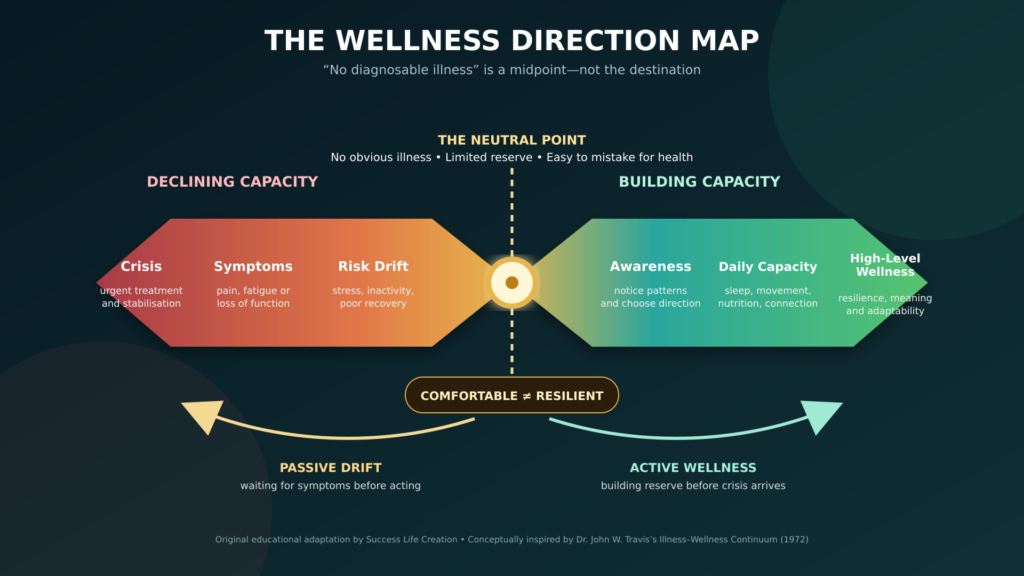
In Dr. John W. Travis’s 1972 model, the Wellness Continuum extends from worsening illness on one side to progressively higher wellness on the other. At the centre is a neutral point—no discernible illness, but also no special reserve, vitality or growth. Treatment may help someone move from symptoms toward neutral; wellness practices help movement beyond neutral.
A language clarification: “Most dangerous” is intentionally provocative, not a clinical ranking. Acute illness and emergencies are plainly more dangerous. The neutral point is dangerous in a quieter sense: it can create false reassurance, delay prevention and allow risks to accumulate without urgency. |
The Mistake: Defining Health as the Absence of Disease
For generations, many people have understood health in binary terms: either you have a disease or you do not. This definition is useful for diagnosis, but incomplete for living. The World Health Organization’s constitution describes health as physical, mental and social wellbeing—not merely the absence of disease or infirmity.
A normal result answers a specific question at a specific time. It does not automatically measure sleep quality, muscular strength, cardiorespiratory fitness, emotional regulation, social connection, meaning, metabolic reserve or the direction in which these are changing.
The Wellness Continuum therefore reframes health from a status to a trajectory. “Where am I?” matters, but “Which way am I moving?” may matter even more.
Why Neutral Feels So Safe
1. There Is No Immediate Pain
Human attention responds strongly to discomfort and crisis. When nothing hurts, preventive action competes with work, family, screens and convenience. The absence of pain becomes permission to postpone.
2. Daily Function Can Hide Declining Reserve
You may still complete your tasks while relying on longer recovery, caffeine, weekend sleep or sheer willpower. Functioning is not the same as flourishing. Reserve becomes visible when life demands more—an infection, stressful month, injury, bereavement or major responsibility.
3. Slow Change Is Difficult to Notice
A small annual decline in strength, mobility, sleep or waist circumference rarely feels dramatic. Because each step is modest, the new normal is accepted. By the time the pattern becomes undeniable, reversing it may require much more effort.
4. “Normal” Can Be Misunderstood
Reference ranges and screening thresholds are valuable clinical tools, but they are not personal guarantees. Results must be interpreted in context—age, symptoms, medical history, medications, trends and professional judgment. A number near a threshold may deserve attention even when it has not crossed a diagnostic line.
What May Be Hiding at the Neutral Point?
The neutral zone is not a diagnosis. It is a useful lens for patterns that are easy to normalise:
- Energy without vitality: You can complete the day, but almost nothing remains for play, creativity or relationships.
- Sleep without restoration: You spend enough hours in bed yet wake unrefreshed or depend on irregular catch-up sleep.
- Movement without capacity: Routine tasks are manageable, but stairs, carrying weight, balance or sustained walking are becoming harder.
- Food without nourishment: There is enough food, but choices repeatedly produce energy swings, poor satiety or little dietary variety.
- Connection without belonging: You communicate constantly yet have few conversations where you feel heard and supported.
- Success without meaning: Life appears productive from outside while internally feeling mechanical or directionless.
Do not self-diagnose: Persistent fatigue, sleep disturbance, pain, mood changes or reduced function deserve qualified assessment. Lifestyle reflection complements medical care; it does not explain every symptom. |
The Difference Between Being Stable and Being Resilient
A bridge can appear stable on a calm day. Its true strength is revealed under load. Human resilience works similarly. High-level wellness does not mean never becoming ill. It means building physical, emotional and social capacity that may help you respond, recover and adapt when life changes.
That capacity is not created by one detox, one supplement, one retreat or one month of discipline. It grows through repeated foundations: appropriate healthcare, consistent sleep, regular movement, nourishing food, emotional support, meaningful relationships, purpose and recovery.
The right side of the Wellness Continuum is not perfection. It is participation—actively building the resources with which you meet life.
Five Questions That Reveal Your Direction
- Compared with one year ago, is my everyday energy improving, stable or declining?
- Am I building strength, mobility and endurance—or only avoiding obvious discomfort?
- Do my sleep and recovery practices restore me reliably?
- Are my closest relationships becoming more supportive and honest?
- Do I respond to early warning signs, or wait until they disrupt my life?
Answer with evidence, not intention. Look at your calendar, step count, bedtime pattern, food routine, medical follow-ups and meaningful conversations. Wellness becomes clearer when it is observable.
How to Move Beyond Neutral—Without Overhauling Your Life
- Create a baseline. Record sleep, energy, movement, mood and one relevant health measure for two weeks. Trends are more useful than isolated good days.
- Choose one capacity. Improve the area with the greatest combination of importance and readiness—not necessarily the one producing the most guilt.
- Make the action repeatable. A 15-minute walk performed consistently can build more capacity than an extreme plan abandoned after five days.
- Use professional guidance. Screening, medication review, physiotherapy, nutrition care or mental-health support may be essential parts of movement toward wellness.
- Review direction monthly. Ask what improved, what resisted change and which environmental support is missing. Adjust without self-condemnation.

Treatment and Wellness Are Partners
The wellness approach should never be used to imply that illness results from weak commitment or that medical treatment is unnecessary. Treatment can relieve symptoms, control disease, prevent complications and save life. Wellness practices can support function, quality of life and future capacity. They serve different but complementary purposes.
A person living with diabetes, arthritis, disability or another chronic condition may be strongly oriented toward wellness through informed care, movement, connection, purpose and self-respect. Conversely, a person with no diagnosis may be moving left through chronic stress, isolation, inactivity and avoidance.
Do Not Wait for the Alarm
The neutral point is seductive because it asks nothing from us today. There is no crisis, no deadline and no dramatic consequence. But health is being shaped quietly—in the ordinary evenings, meals, walks, conversations and decisions that rarely feel important enough to remember.
The central message of the Wellness Continuum is not “fear disease.” It is “build life.” Do not wait until the body must shout before you begin to listen. “Not sick” may be a relief—but it was never meant to be your highest definition of health.
Final reflection: If nothing is seriously wrong, that is good news. Use the breathing space not merely to remain at neutral, but to build the strength, connection and meaning that make wellness visible in how you live. |