The Success Formula Is a Loop,
Not a Line
How Meaning, State, Choice and Repetition Create Results
You think positively. Next, you feel motivated. Then, you take action. Finally, you expect results. The formula sounds beautifully simple: Thoughts → Feelings → Actions → Results.
But life quickly exposes the missing pieces. A useful thought can arise while the body remains exhausted. A powerful feeling can disappear before action begins. One inspired action can be followed by twenty ordinary days of inconsistency. And a good process can temporarily produce a disappointing result.
The familiar formula is not wrong—it is incomplete. A more realistic Success Formula must explain how circumstances are interpreted, how the nervous system influences action, how choices become habits and how results return as feedback.
The upgraded formula: Event → Meaning → State → Choice → Repetition → Results → Feedback. Success is not merely a chain. It is a learning loop. |
Two Powerful Foundations
Jack Canfield: E + R = O
Jack Canfield teaches E + R = O: Event + Response = Outcome, a formula he credits to psychotherapist Dr. Robert Resnick. The event may be difficult, unfair or outside our control. The response is where thinking, communication and behaviour can often be changed. The outcome reflects both reality and our response to it.
The strength of this model is responsibility. It moves us from “Why did this happen to me?” toward “What response is available now?” Its limitation appears when responsibility is interpreted as total control. Genetics, illness, discrimination, poverty, caregiving demands and access to opportunity are real influences. Responsibility is the power to participate in the next response—not proof that every outcome was personally chosen.
Bob Burg: Desire, Learn, Apply, Persist, Believe
Bob Burg’s *The Success Formula* emphasises Desire → Learn → Apply → Persist → Believe. It adds ingredients missing from momentary motivation: a meaningful aim, knowledge, execution and persistence. Burg’s wider work also places value creation at the centre of sustainable business success.
The strength here is movement. Desire without learning remains enthusiasm; knowledge without application remains information; action without persistence rarely compounds.
Why Thoughts Do Not Determine Everything
Thoughts matter because interpretation influences emotion, attention and behaviour. Yet not every thought is consciously selected, accurate or powerful enough to dictate action. People can act according to values while anxious, exercise while unmotivated and prepare a healthy meal while craving convenience.
This is important for wellness: waiting to “feel right” can delay the behaviour that helps the body and mind feel better. Action sometimes follows emotion—but emotion can also follow action.
A mature Success Formula therefore respects thoughts without worshipping them. A thought is an input, not a command.
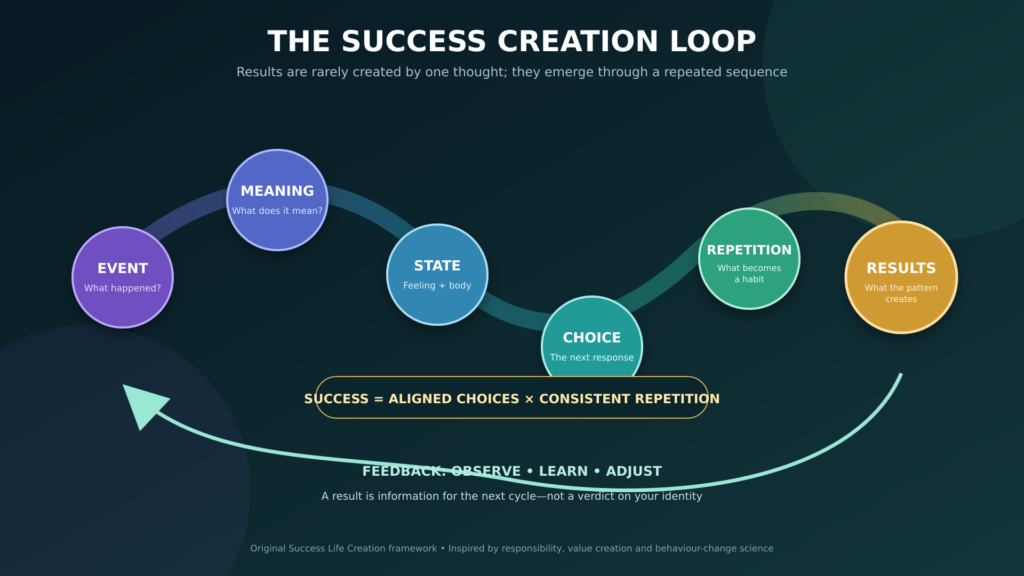
The Success Creation Loop—Decoded
1. Event: What Actually Happened?
An event may be external—a rejection, diagnosis, market change or missed target—or internal, such as fatigue or fear. Begin with observable facts. “The proposal was declined” is an event; “Nobody values me” is an interpretation.
2. Meaning: What Story Did You Attach?
The same event can mean “I am incapable,” “the strategy needs revision,” or “this is not the right fit.” Meaning is where beliefs, memories and assumptions enter. Changing meaning does not require denying pain; it requires separating evidence from automatic conclusion.
3. State: What Happened in Mind and Body?
Meaning influences emotional and physiological state—confidence or shame, curiosity or threat, openness or defensiveness. Sleep, hunger, pain and stress also shape state. A dysregulated body can make a reasonable action feel impossible.
4. Choice: What Is the Next Workable Response?
Choice is smaller than destiny. It may be one phone call, one honest conversation, one glass of water, one ten-minute walk or one request for professional help. The best choice is not the most dramatic; it is aligned, safe and repeatable.
5. Repetition: What Becomes a Pattern?
Results are rarely created by one action. Repetition in a stable context helps behaviour become more automatic. Research on health habits shows substantial variation, but consistent enactment—not one burst of willpower—is the central mechanism.
6. Results and Feedback: What Did the Pattern Produce?
A result may be success, partial progress or useful failure. Treat it as data: What worked? What resisted? What changed in the environment? Feedback then returns to the beginning of the next cycle.
The compact equation: Success = Aligned Choices × Consistent Repetition. If either alignment or repetition approaches zero, the result weakens. |
A Wellness Example: The 6:00 a.m. Exercise Goal
Event: You miss two early workouts. Meaning: “I have no discipline.” State: shame and discouragement. Choice: abandon the plan. Repetition: repeated avoidance. Result: declining fitness—and the result seems to confirm the original story.
Now change the loop. Event: two missed workouts. Meaning: “The timing may not fit my sleep and responsibilities.” State: curiosity rather than shame. Choice: walk for 15 minutes after lunch. Repetition: link the walk to a daily meal. Result: greater consistency. Feedback: extend the walk gradually.
The event did not need to change. The meaning, state and response did.
Five Questions That Interrupt an Unhelpful Loop
- What are the facts—and what is the story I added?
- What physical or emotional state is influencing this decision?
- What choice would align with my values even if motivation stays low?
- How can I attach that choice to a stable cue or routine?
- What will I measure as feedback rather than as a judgment of my worth?
Build an If–Then Bridge
Good intentions often fail at the moment of friction. An implementation intention converts aspiration into a cue-linked response:
- Wellness: If I finish lunch, then I will walk for ten minutes.
- Emotional regulation: If I notice myself reacting defensively, then I will take three slow breaths before replying.
- Leadership: If a team member brings a problem, then I will ask two questions before giving advice.
- Learning: If I open social media during my study block, then I will close it and complete five focused minutes first.
Research indicates that specific if–then plans can improve goal attainment. They do not eliminate difficulty; they reduce the number of decisions required when difficulty arrives.

Success Must Include Wellness
A formula that produces income while destroying sleep, relationships and health is not complete success. Bob Burg reminds us that success is contextual; Jack Canfield emphasises intentional response. A wellness-oriented definition adds sustainability: the process should not consume the person pursuing the result.
Ask not only, “Did I achieve it?” Ask: “Who did I become, what value did I create and can my body, relationships and integrity survive the method?”
Your Results Are Data—not Destiny
You cannot control every event. You cannot always control the first thought, first feeling or immediate physiological reaction. But you can often influence meaning, regulate state, choose a next response, design supportive cues and repeat what works.
That is the deeper Success Formula: not absolute control, but increasing participation. Not endless positive thinking, but honest interpretation. Not heroic action, but aligned repetition. Not fear of failure, but feedback.
Success is not created once. It is created, observed and corrected—again and again.
Final reflection: The event begins the cycle. Your meaning shapes the state. Also, your state influences the choice. Repeated choices create results. And every result gives you the wisdom to begin the next cycle differently. |