When the World Goes Dark
The Hidden Power of Structured Thinking in Stress, Isolation, and Panic
Author’s Note:
“The specific Cold War experiment described in a viral reel circulating in Social Media is difficult to independently verify; this article uses it as a reflective story while drawing from established research on sensory deprivation, isolation, stress, and structured mental coping.”
Research does support that sensory deprivation can produce perceptual distortions and hallucination-like experiences, and space agencies actively study isolation and confinement as serious psychological stressors for astronauts.
What Happens When the Mind Has Nothing to Hold on to?
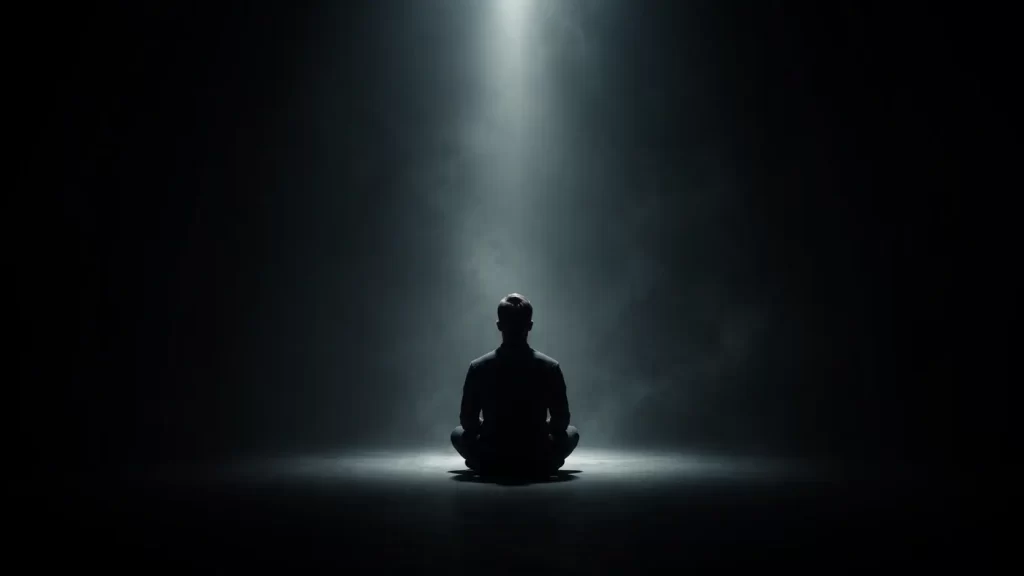
Imagine being locked in complete darkness.
No light.
No sound.
No phone.
No human voice.
No clock.
No signal from the outside world.
Only you, your breath, your heartbeat, and your thoughts.
A viral reel recently shared a fascinating story: in the 1960s, during the Cold War era, scientists allegedly placed men in total darkness for 48 hours to study how the human mind behaves under extreme sensory deprivation. According to the story, most participants broke down psychologically. But one man did not. He remained mentally clear. He survived the full duration not because he was physically stronger, but because he kept his mind structured.
He was described as an engineer and chess player. Instead of allowing his mind to float into fear, emptiness, or hallucination, he mentally reconstructed chess games, designed buildings, broke down engines in his imagination, and kept his inner world active with ordered thought.
The reel called this technique “vacuum structuring.”
Whether this Cold War story is literal history, partially true, or a symbolic retelling, its central lesson is deeply relevant today:
When the outer world becomes uncertain, the inner world must become structured.
This is not only a survival principle. It is a life principle.
In darkness, structure becomes light.
In panic, structure becomes oxygen.
In uncertainty, structure becomes direction.
Sensory Deprivation: Why the Mind Becomes Restless in Silence
The human brain is not designed to remain passive. It is constantly processing information — light, sound, temperature, smell, touch, movement, human expression, social cues, and environmental changes. Even when we are not consciously thinking, the brain is still scanning, predicting, remembering, imagining, and interpreting.
When external stimulation suddenly disappears, the brain does not simply become quiet. Instead, it may start producing its own internal stimulation.
That is why people in extreme isolation, total darkness, or silence may experience time distortion, anxiety, vivid imagery, intrusive thoughts, and sometimes hallucination-like experiences.
The brain wants input. If the outside world gives none, the inside world begins to generate its own.
This is why silence can be peaceful in short, voluntary doses, but disturbing when it is forced, prolonged, or combined with fear. Meditation in a safe room is one thing. Isolation without choice is something else.
In the viral story, most participants reportedly began to lose their mental stability because their minds had no external anchor. The one man who endured created an internal anchor. He gave his mind work to do.
That is the genius of structured thinking.
The Core Principle: Never Let the Mind Fall into Unstructured Fear
When people panic, the problem is not only the situation outside. The deeper problem is often the lack of structure inside.
A mind without structure begins to loop.
“What will happen?”
“What if I fail?”
“What if I lose everything?”
“What if people leave me?”
“What if I never recover?”
“What if this pain never ends?”
“What if I am not strong enough?”
These questions may appear logical, but under stress they become circular. They do not solve. They only intensify fear.
Unstructured fear is like a dark room where the mind starts projecting monsters on the wall.
Structured thinking switches on a lamp.
It tells the mind:
“First, breathe.”
“Now, observe.”
“Now, name the problem.”
“Now, divide time.”
“Now, do one task.”
“Now, complete the next step.”
This is why soldiers, astronauts, emergency responders, surgeons, athletes, and high-performance leaders rely on routines, checklists, simulations, drills, and mental rehearsal. In pressure situations, they do not depend on mood. They depend on structure.

What Is “Vacuum Structuring”?
The phrase “vacuum structuring” is not a commonly used mainstream psychological term, but it is a powerful way to describe a real mental principle.
A vacuum is an empty space. Structure is order. So, “vacuum structuring” means creating order inside emptiness. It is the act of giving the mind a sequence of meaningful tasks when external reality offers no guidance, no comfort, and no stimulation.
In the viral story, the man did three things:
- He gave his mind detailed tasks.
- He used imagination with precision.
- He divided time internally.
He did not simply “think positive.” He did something much stronger. He kept his cognitive system engaged.
He mentally played chess, each move by move.
He imagined machines, part by part.
He designed buildings, layer by layer.
He created an inner architecture strong enough to protect him from the psychological vacuum outside.
This is a profound lesson.
The mind cannot remain empty for long. If we do not give it a constructive structure, it may create a destructive one.
Why Chess, Engineering, and Visualization Worked
The man in the story reportedly used chess and engineering because both require sequential thinking.
Chess requires memory, anticipation, strategy, pattern recognition, and decision-making. You cannot mentally play chess in a vague way. You must see the board. You must remember positions. You must calculate consequences.
Engineering also demands structure. If you imagine an engine, you must think of its parts, movement, alignment, function, and relationship. If you design a building, you must think of foundation, walls, space, support, entry, light, and flow.
These tasks protect the mind because they are:
- Ordered
- Detailed
- Sequential
- Purposeful
- Mentally absorbing
Fear thrives in vagueness. Clarity thrives in sequence. That is why “structured mental work” can become a powerful tool during emotional storms.
Modern Relevance: We Are Not in Dark Rooms, But Many Minds Are in Darkness
Most of us may never be locked in a dark isolation chamber. But many people today live in a different kind of darkness.
The darkness of anxiety.
The darkness of uncertainty.
The darkness of loneliness.
The darkness of financial pressure.
The darkness of health fear.
The darkness of overthinking.
The darkness of digital noise.
The darkness of emotional exhaustion.
Modern life gives us too much stimulation and too little structure.
Notifications, reels, arguments, news, deadlines, family expectations, health concerns, career pressure, and comparison on social media keep the mind constantly activated. But activation is not the same as clarity.
A person can be busy and still mentally scattered.
A person can be surrounded by people and still feel isolated.
A person can consume information all day and still feel directionless.
This is where the lesson becomes powerful:
When life feels chaotic, do not wait for the world to become calm. Create structure inside your mind.
The Mind Under Stress: Why Structure Calms the System
Stress often creates a sense of helplessness because the mind tries to process everything at once. When the mind sees a problem as one giant mountain, it freezes. But when the same problem is divided into smaller steps, the nervous system begins to relax. This is why people feel calmer after making a list. The external situation may not have changed, but the mental map has changed.
A list says: “This is not infinite. This can be broken down.”
A schedule says: “Time is not attacking me. I can organise it.”
A routine says: “I know what to do next.”
A breathing practice says: “My body has a way back to balance.”
A written plan says: “I am not helpless.”
Structure brings the brain back from emotional flooding into executive function — the part of us that can observe, prioritise, decide, and act.

Practical Technique: The 5-Step Mental Structuring Method
Here is a simple version of this principle that anyone can use during stress, anxiety, panic, sleeplessness, or emotional overwhelm.
Step 1: Name the State
Start by naming what is happening.
Say silently:
“I am feeling anxious.”
“I am feeling overwhelmed.”
“My mind is racing.”
“My body feels unsafe, but I am here.”
Naming the state creates distance. You are no longer completely inside the emotion. You are observing it.
Step 2: Divide Time into Blocks
Do not try to manage the whole day, whole week, or whole life.
Begin with a small block.
For example:
“For the next 10 minutes, I will only focus on breathing and grounding.”
“For the next 20 minutes, I will write down the problem.”
“For the next 30 minutes, I will clean one area.”
“For the next 1 hour, I will work on one task.”
The mind calms when time becomes measurable.
Step 3: Give the Mind a Constructive Task
Choose a task that requires attention but does not create more panic.
Examples:
- Count backward from 300 by 7
- Mentally walk through your childhood home room by room
- Reconstruct a favorite song in your mind
- Visualize preparing a simple meal step by step
- Plan tomorrow morning in detail
- Recall 20 people you are grateful for
- Mentally arrange your books, clothes, or workspace
- Solve a puzzle, prayer sequence, mantra count, or memory exercise
The purpose is not entertainment. The purpose is mental anchoring.
Step 4: Use Detailed Visualization
Vague imagination can become fear. Detailed imagination can become structure.
For example, instead of saying, “I want peace,” visualize the process:
You wake up.
You drink water.
You stretch.
You breathe slowly.
You sit near a window.
You write three priorities.
You make one phone call.
You complete one action.
The more detailed the sequence, the safer the mind feels.
Step 5: Return to One Physical Action
Mental structuring must eventually return to the body.
Do something small and physical:
- Drink water
- Wash your face
- Stand up straight
- Breathe deeply
- Write one sentence
- Step outside for sunlight
- Call a trusted person
- Arrange your desk
- Walk for five minutes
Physical action tells the nervous system: “I am not trapped.”
Application in Insomnia: When the Night Becomes Too Loud
Many people experience mental darkness at night. The room is quiet, but the mind is noisy.
Regrets from the past arise.
Fear of the future begins.
Unfinished tasks become larger.
The imagination turns small problems into disasters.
Instead of fighting sleep, use structured mental engagement.
Try this:
- Mentally review your day in reverse order
- Count 50 slow breaths
- Visualize walking through a peaceful place step by step
- Repeat a calming phrase slowly
- Plan tomorrow’s first three actions
- Relax the body part by part, from toes to forehead
The goal is not to force sleep. The goal is to give the mind a gentle structure so it stops generating random fear.
Application in Direct Selling and Leadership
This lesson is especially powerful for direct sellers, entrepreneurs, trainers, and leaders.
In direct selling, uncertainty is part of the journey.
Some people will say no.
Some prospects will not respond.
Some team members will slow down.
Some months will be strong.
Some months will test your belief.
If the mind is unstructured, every rejection becomes personal. Every delay becomes failure. Every comparison becomes pain.
But a structured mind says:
“I will do my calls.”
“I will follow up with dignity.”
“I will study for 30 minutes.”
“I will improve my product knowledge.”
“I will serve people, not chase people.”
“I will measure activity before judging results.”
This is mental survival in business.
Success does not come only from motivation. Motivation rises and falls. Structure keeps moving.
A leader is not someone who never feels fear.
A leader is someone who knows what to do when fear appears.
Application in Wellness and Healing
Health journeys also require structured thinking.
When a person receives a diagnosis, sees abnormal reports, or faces chronic symptoms, the mind can easily enter panic.
“What if this becomes worse?”
“What if I cannot recover?”
“What if my body is failing?”
But healing requires calm participation.
Structured thinking helps a person ask better questions:
“What can I improve today?”
“What food choice supports me?”
“What movement is safe for me?”
“What sleep habit can I correct?”
“What medical guidance do I need?”
“What emotional pattern needs attention?”
Wellness begins when fear turns into informed action.
This does not mean ignoring medical advice. It means becoming an active partner in one’s own wellbeing.
The Danger of an Empty Mind in a Noisy World
There is a strange paradox today.
We are overstimulated externally but under-structured internally.
We scroll endlessly but reflect rarely.
We consume content but do not digest wisdom.
We react quickly but plan slowly.
We know many things but practice very few.
An empty mind is not always silent. Sometimes it is overcrowded with borrowed thoughts.
That is why inner structure is now a modern survival skill.
We need daily rhythms.
We need reflection.
We need meaningful questions.
We need disciplined attention.
We need conscious breathing.
We need mental routines that protect us from emotional collapse.
A Simple Daily Practice: The Inner Structure Routine
Use this 10-minute practice every morning or whenever the mind feels scattered.
Minute 1–2: Breathing
Sit comfortably. Inhale slowly. Exhale longer than you inhale. Let the body receive the message of safety.
Minute 3–4: Emotional Naming
Ask: “What am I feeling right now?”
Name it without judgement.
Minute 5–6: Mental Clearing
Write down all unfinished thoughts. Do not organize yet. Just empty your mind onto paper.
Minute 7–8: Priority Selection
Choose only three priorities for the day.
Not ten. Not twenty. Three.
Minute 9–10: Visualization
Mentally rehearse yourself completing the first priority calmly and confidently.
This small practice creates mental order before the world begins making demands.
The Deeper Spiritual Lesson: Inner Order is Inner Power
In many spiritual traditions, darkness is not only a symbol of fear. It is also a symbol of potential.
Seeds grow in darkness.
The child develops in the womb.
Deep rest happens at night.
Silence can become prayer.
Stillness can become wisdom.
But darkness becomes dangerous when we lose awareness inside it.
The goal is not to fear darkness. The goal is to bring consciousness into it.
Structured thinking is one way of carrying a lamp within.
When the outside world is uncertain, the awakened mind says:
“I will not collapse into chaos.”
“I will create order.”
“I will breathe.”
“I will observe.”
“I will choose.”
“I will act.”
This is not denial. This is discipline.
Final Reflection: The Mind Needs Direction
The viral story of the man who survived 48 hours in darkness gives us a memorable metaphor for life.
We may not face a laboratory chamber. But we will face our own chambers of uncertainty.
A health crisis.
A financial challenge.
A business setback.
A lonely night.
A painful rejection.
A season of confusion.
A moment when the future feels dark.
In those moments, the mind must not be left alone with fear.
Give it structure.
Give it breath.
Give it sequence.
Give it meaningful work.
Give it a next step.
Because the mind, when untrained, can create panic inside silence.
But the mind, when disciplined, can create light inside darkness.
Conclusion: When Reality Feels Chaotic, Structure Your Inner World
The greatest lesson from this story is simple:
When external reality becomes overwhelming, give the mind structured, step-by-step tasks.
This is the foundation of resilience.
Not blind positivity.
Not forced motivation.
Not pretending everything is fine.
Real resilience is the ability to create order when life feels disorderly.
So, the next time you feel anxious, restless, overwhelmed, or mentally trapped, remember this:
Do not let the mind fall into the vacuum.
Structure the moment.
Structure the breath.
Structure the next action.
Structure the day.
Structure the inner dialogue.
And slowly, the darkness will no longer feel empty.
It will become the space where your inner strength awakens.
Call to Action
At Success Life Creation, we believe that personal transformation begins with awareness, discipline, and conscious action.
If this reflection touched you, take one small step today:
Write down one area of life where your mind needs more structure.
Then ask yourself:
“What is the next clear action I can take?”
Not tomorrow.
Not someday.
Today.
Because sometimes, the light we are searching for outside begins with the structure we create inside.